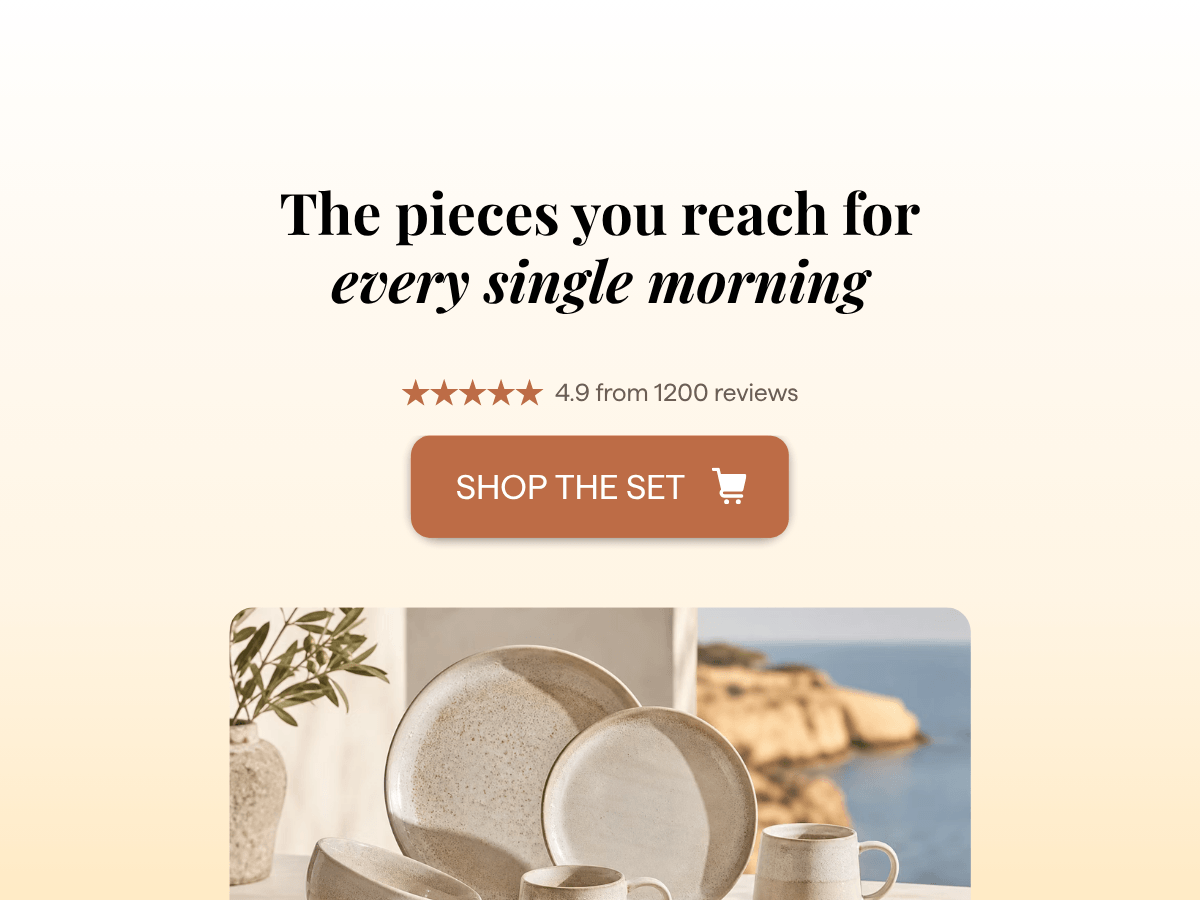
Descripción general de la plantilla
La plantilla de landing page DTC es un escaparate para un solo producto que hace mucho más que mostrarlo. Guía a los visitantes por la historia de la marca, su fundador, el estudio, los materiales y las reseñas; después, recoge la dirección de envío y cobra la tarjeta en la página siguiente. Toda la compra se realiza dentro de un único funnel, en una única URL y sin un proceso de pago de Shopify separado.
La plantilla está creada para marcas que producen en lotes pequeños y para las que cada cliente importa. Estudios de cerámica, fabricantes de velas, tostadores de café, líneas de cuidado de la piel, artículos de cuero y marcas de moda sostenible. El tipo de producto cuya historia motiva la compra y para el que una página de producto genérica supone perder ingresos. Úsala para lanzar un producto nuevo, realizar una campaña de tráfico de pago o sustituir la página de inicio por un único SKU estrella.
Todas las secciones son editables. Cambia las fotos, reescribe la historia del fundador, modifica el precio, conecta el bloque de pago con tu cuenta de Stripe o PayPal y publica. El formulario de envío, la calculadora de descuentos y el bloque de pago ya vienen configurados para que el comprador pase de «comprar el conjunto» a «gracias por tu pedido» en tres páginas.
Funciones principales
Cobro integrado. La página final cobra mediante Stripe o PayPal en EUR, USD, GBP o cualquier moneda que configures. Tarjeta, PayPal, EPS, iDEAL y débito directo SEPA funcionan desde el mismo bloque de pago.
Calculadora de descuentos. Un campo de fórmula lee la casilla de suscripción al boletín y aplica un descuento antes de que el comprador llegue al bloque de pago. Casilla del boletín marcada = 5% de descuento. Sin marcar = precio completo. Cambia el porcentaje en un solo lugar.
Secciones narrativas con desplazamiento. Sección principal, logotipos de medios, testimonio, historia del fundador, foto del estudio, explicación del proceso en tres pasos, tarjetas de materiales y una CTA final. Todo vertical, editable e intercambiable.
Formulario de dirección de envío. El formulario de contacto recopila nombre, apellidos, email, teléfono, dirección, ciudad y país antes del pago para que puedas tramitar el pedido al instante. Los campos obligatorios se validan.
Acordeón de preguntas frecuentes. Un bloque prediseñado de preguntas frecuentes responde a las dudas que impiden que los compradores hagan clic en comprar. Seguridad en el lavavajillas, tiempo de producción, repuestos, envíos internacionales y variaciones de color. Edita las preguntas para adaptarlas a las consultas que realmente recibe tu equipo de soporte.
Ventajas
Los clientes compran en la misma página en la que te descubren, por lo que el tráfico no se desvía a un proceso de pago independiente que hace perder entre un 20-30% de la intención de compra.
La historia de la marca aparece antes del botón de compra, por lo que quienes llegan sin conocerte desde un anuncio de pago descubren al fundador, el estudio y el proceso antes de ver el precio.
La calculadora de descuentos convierte las suscripciones al boletín en pedidos. El 5% de descuento está condicionado a una casilla, por lo que quienes no se suscriben pagan el precio completo y quienes sí lo hacen se sienten recompensados.
El formulario de envío bloquea los registros basura porque los campos de dirección y email son obligatorios, por lo que los pedidos que llegan a tu sistema son reales e incluyen datos de envío válidos.
El bloque de pago cobra la tarjeta en cuanto el comprador hace clic en pagar. Sin redirecciones al proceso de pago de Stripe, sin carritos abandonados en un dominio de terceros y sin pasos adicionales en los que Apple Pay tarda en cargar y el comprador se marcha.
Preguntas frecuentes
-
A direct-to-consumer landing page is a single-product page that sells without sending the buyer to a separate ecommerce site. It carries the brand story, the social proof, the product details, and the checkout in one continuous flow. Used by indie brands, small-batch makers, and any seller where the story is the reason the product is worth more than a commodity equivalent.
-
No. The template is a full standalone landing page with payment collection built in. You point the payment block at your Stripe, PayPal, or Square account and the funnel handles the order. If you already have Shopify, you can still use the funnel as an ad landing page and pass the order to Shopify through Zapier or webhooks.
-
Stripe, PayPal, and Square. Stripe alone handles cards, EPS, iDEAL, and SEPA Direct Debit. PayPal handles PayPal. Square handles cards. You connect your own account in settings and funds land in your bank, not in involve.me.
-
Yes. The payment block has a currency dropdown. EUR, USD, GBP, AUD, CAD, and most other currencies your payment provider supports are available. Set it once in the payment block and the calculator field updates to match.
-
The newsletter checkbox on the shipping page is wired to a calculator formula. If the buyer checks the box, the formula multiplies the price by 0.95 and the payment block charges the discounted amount. If the buyer leaves it unchecked, the full price stays. Change the percentage by editing one formula.
-
The template is built for a single hero product, which is the configuration that converts best for DTC. If you want to offer variants or bundles, duplicate the funnel per product or add a question step that branches the buyer to the right outcome page. Score-based or Answer-based outcomes can route different buyers to different product configurations.
-
Yes. Every section stacks vertically and adapts to phone screens. The hero, the founder story, the process cards, the testimonials, the FAQ, and the payment block all reflow for narrow viewports. Mobile is the default for most DTC paid traffic, so the template is tested there first.
-
A/B testing is built in with involve.me. Change the headline, the hero image, the price, or the founder story, and the platform splits traffic between 2 versions automatically. Per-variant conversion rate shows up in the same analytics dashboard, so you do not need an external split tester.
-
The shipping form is a contact form component pre-configured with first name, last name, email, phone, street address, city, and country. Required fields are enforced before the buyer can advance to payment. Add or remove fields by editing the contact form in the funnel editor.
-
The buyer sees a thank you message, and the order data, shipping address, and payment confirmation are stored in the funnel submission. From there, the order can route to your fulfillment tool, your CRM, or your accounting tool through native integrations or through Zapier and webhooks. Built-in email automation sends the receipt and shipping notification without a separate ESP.
-
Yes. Built-in email automation is part of the platform. Trigger a receipt email on payment, a shipping notification when the order is fulfilled, a check-in email two weeks later, and a reorder reminder at the right interval. Sequences run inside involve.me without a Mailchimp, Klaviyo, or ConvertKit handoff, though those tools connect natively if you already use one.
-
The template includes a required consent checkbox for personal data processing before the buyer can submit. involve.me is SOC 2 Type II certified and GDPR-compliant, and data is hosted in EU data centers. You provide the privacy policy URL and the popup text. Newsletter opt-in is a separate checkbox so consent is recorded explicitly for each purpose.
-
It depends on the level of customization you need, but you can customize and publish a working version in under an hour. Open the template, swap the product images, rewrite the headline and founder story, connect your Stripe or PayPal account, and click publish. The first paying order can land the same day the page goes live.


